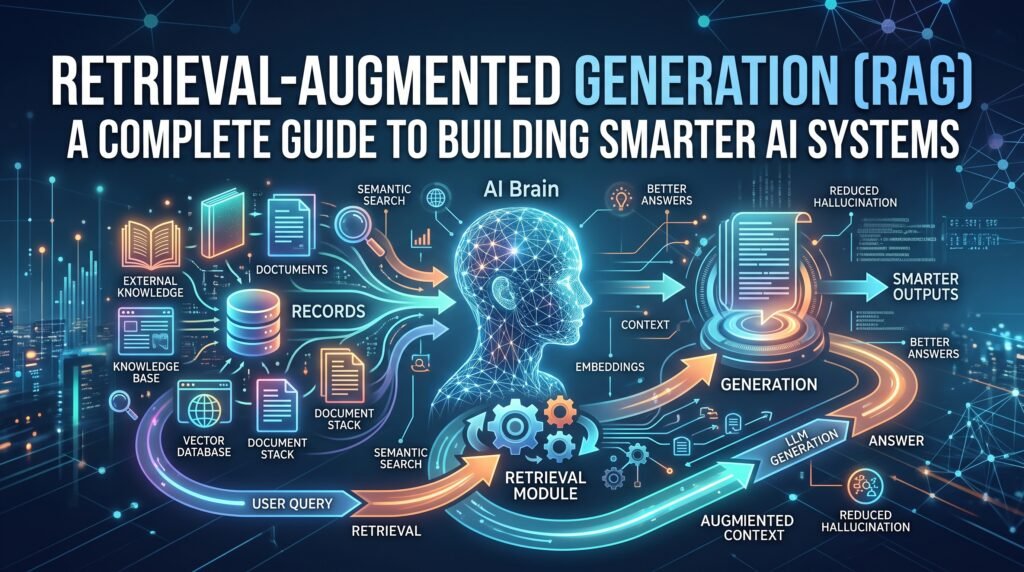
Retrieval-Augmented Generation (RAG) is an AI architecture that improves Large Language Models by connecting them with external knowledge sources.
A normal AI model generates responses using its existing training data. A RAG system adds another step: before answering, it searches for relevant information from connected sources and uses that information as context.
The term RAG has three parts:
Retrieval
Retrieval means finding relevant information from external sources.
These sources can include:
- Business documents
- Websites
- Databases
- Knowledge bases
- Research materials
- Product information
The system searches these sources to find information related to the user’s question.
Augmentation
Augmentation means enhancing the AI model with additional context.
The retrieved information is temporarily provided to the AI model, helping it understand the specific situation and respond with more relevant information.
Generation
Generation is the final step where the AI creates a natural-language response.
The answer is produced using:
- The user’s question
- Retrieved information
- The language capabilities of the AI model
This combination creates responses that are more accurate and business-specific.
Why Was RAG Developed?
Although modern AI models are powerful, they have limitations that make them difficult to use in many professional environments.
Reducing AI Hallucinations
One of the biggest challenges with AI is hallucination.
Hallucination happens when an AI system generates information that sounds correct but is inaccurate.
For example, a general AI model may answer a question about a company’s refund policy without actually knowing the company’s rules.
RAG reduces this problem by connecting AI responses with verified information sources.
Instead of relying on assumptions, the system retrieves relevant documents and generates answers based on available knowledge.
Giving AI Access to Private Business Information
Every organization has unique knowledge that general AI models do not contain.
Examples include:
- Internal procedures
- Customer support guidelines
- Product documentation
- Employee resources
- Technical information
RAG allows companies to connect AI systems with their own data, creating customized assistants without building a completely new AI model.
Keeping Information Updated
Business information changes constantly.
Policies are updated, products evolve, and new documents are created.
Traditional AI models require additional training to learn new information. RAG provides a simpler approach.
Businesses can update their knowledge sources, allowing the AI system to work with fresh information without retraining the entire model.
How Does RAG Work?
A RAG system follows a structured process that connects user questions with relevant information.
1. Collecting Knowledge Sources
The first step is gathering information that the AI system will use.
Common sources include:
- PDF files
- Websites
- Databases
- Product manuals
- Customer support articles
- Internal documents
The goal is to create a reliable knowledge foundation.
2. Preparing and Organizing Data
Raw information must be prepared before AI can use it.
This process includes:
- Removing outdated content
- Cleaning documents
- Organizing information
- Splitting large files into smaller sections
Large documents are usually divided into smaller sections called chunks.
This helps the system quickly find the most relevant information.
3. Creating Embeddings
Embeddings allow AI systems to understand the meaning behind information.
Instead of matching only exact words, embeddings help the system identify similar concepts.
For example:
“How can I cancel my membership?”
and
“Steps to end a subscription plan”
have different wording but similar meaning.
Embeddings help AI recognize this relationship.
4. Storing Information in Vector Databases
After creating embeddings, information is stored in vector databases.
These databases allow AI systems to search information based on meaning rather than simple keywords.
Popular technologies include:
- Pinecone
- Weaviate
- Chroma
- FAISS
5. Retrieving Relevant Information
When a user asks a question, the system searches the database and identifies the most useful information.
It considers:
- Meaning
- Context
- Relevance
- Document quality
Only the most useful information is sent to the AI model.
6. Generating the Final Response
The AI model receives:
- User question
- Retrieved information
- Response instructions
It then creates a natural and context-aware answer.
This process allows AI systems to provide responses based on trusted knowledge instead of assumptions.
RAG Architecture Explained
A complete RAG system contains several connected components.
User Interface
This is where users interact with the AI system.
Examples:
- Chatbots
- Search assistants
- Enterprise applications
Knowledge Base
The knowledge base contains the information used by AI.
Examples:
- Documents
- Databases
- Company resources
Embedding Model
The embedding model converts information into a format that AI systems can search and understand.
Vector Database
The vector database stores and retrieves relevant information efficiently.
Large Language Model
The LLM generates responses using retrieved information.
Examples include GPT-based models, Claude, Gemini, and other advanced language models.
RAG vs Fine-Tuning: Understanding the Difference
RAG and fine-tuning are both methods for improving AI systems, but they solve different problems.
RAG Focuses on Knowledge
RAG answers:
“What information should the AI use?”
It is ideal when businesses need AI systems connected to changing information.
Examples:
- Customer support assistants
- Internal knowledge systems
- Document search tools
Fine-Tuning Focuses on Behavior
Fine-tuning answers:
“How should the AI behave?”
It changes the way an AI model responds.
Examples:
- Brand-specific writing style
- Specialized workflows
- Custom response formats
Can They Work Together?
Yes.
Many advanced AI systems combine both approaches.
Fine-tuning can create consistent behavior, while RAG provides access to accurate and updated knowledge.
Real-World Applications of RAG
Customer Support
RAG-powered assistants can answer customer questions using:
- Product information
- Shipping policies
- FAQs
- Troubleshooting guides
This improves response quality and reduces support workload.
Healthcare
Healthcare organizations can use RAG for:
- Research assistance
- Medical information retrieval
- Documentation support
However, professional review remains essential for sensitive decisions.
Finance
Financial organizations use RAG for:
- Document analysis
- Compliance information
- Internal knowledge systems
Legal Services
Legal professionals can use RAG to search:
- Contracts
- Regulations
- Case information
It helps improve research efficiency.
Education
Educational institutions can build AI assistants connected with:
- Course materials
- Learning resources
- Research documents
Enterprise Knowledge Management
Large organizations can use RAG to help employees quickly access internal knowledge.
Instead of searching through thousands of documents, employees can ask questions naturally.
Benefits of Implementing RAG
More Accurate Responses
By using trusted information sources, RAG creates more reliable AI outputs.
Better Control
Businesses control:
- Data sources
- Available information
- Access permissions
Easier Updates
New information can be added without retraining the entire AI model.
Lower Development Costs
RAG provides customization without the expense of building a completely new AI model.
Improved Productivity
Employees and customers can access information faster through AI-powered assistance.
Challenges of RAG
Data Quality
Poor information creates poor responses.
Organizations must maintain accurate and updated knowledge sources.
Retrieval Accuracy
The system must find the right information to generate useful answers.
Security Concerns
Businesses must protect sensitive information through:
- Access control
- Encryption
- Permission management
Maintenance Requirements
RAG systems require continuous improvement, testing, and monitoring.
How Businesses Can Build a RAG System
Step 1: Define Goals
Organizations should identify:
- The problem they want to solve
- Target users
- Required information sources
Step 2: Prepare Data
Businesses should collect, clean, and organize their information.
Step 3: Select Technology
A RAG system requires choosing:
- AI model
- Embedding model
- Vector database
- Development framework
Step 4: Build and Test
Testing should evaluate:
- Accuracy
- Response quality
- User experience
Step 5: Deploy and Improve
After launch, businesses should continue:
- Updating knowledge
- Monitoring performance
- Improving retrieval quality
The Future of RAG Technology
The future of RAG is moving toward more advanced AI systems.
Multimodal RAG
Future systems will understand:
- Text
- Images
- Audio
- Video
Agentic RAG
AI systems will become more capable of completing tasks, analyzing information, and assisting with workflows.
Real-Time Knowledge Systems
Future RAG applications will connect with live business information, creating faster and more accurate AI experiences.
Is RAG the Future of Enterprise AI?
Businesses are moving toward AI systems that are not only intelligent but also knowledgeable about their specific environment.
RAG represents this shift.
Instead of using general AI models alone, organizations can create customized intelligence connected to their own information.
The future of AI will depend not only on powerful models but also on the ability to access and use the right knowledge at the right time.
Frequently Asked Questions About RAG
What does RAG stand for?
RAG stands for Retrieval-Augmented Generation.
Is RAG the same as ChatGPT?
No. ChatGPT is an AI model, while RAG is an architecture that connects AI models with external information.
Does RAG require training a new AI model?
No. RAG usually works by connecting existing AI models with external knowledge sources.
Can RAG use private company data?
Yes. Businesses commonly use RAG with internal documents and databases.
Is RAG better than fine-tuning?
It depends on the goal. RAG improves knowledge access, while fine-tuning improves behavior.
Conclusion
Retrieval-Augmented Generation is changing how businesses use artificial intelligence.
By connecting powerful AI models with trusted information sources, RAG creates systems that are more accurate, customizable, and useful for real-world applications.
From customer support and enterprise knowledge management to healthcare and research, RAG allows organizations to build AI solutions that understand their unique information.
The future of AI is not only about creating smarter models. It is about creating smarter systems that can access, understand, and apply knowledge effectively.
RAG provides the foundation for that future.