AI is now part of everyday life. People use AI tools to write emails, answer questions, create images, write code, summarize long text, plan content, and even support customers. Many businesses are also adding AI features to their websites, apps, search tools, and online services.
Because AI is growing so quickly, one question keeps coming up:
How much energy does AI use?
The answer is not the same for every AI tool. It depends on the size of the model, the number of users, the type of task, the hardware, and how efficient the data center is. A short text reply does not use the same energy as creating an image, writing long code, or training a large AI model.
AI does use electricity, but the amount can change a lot from one task to another. Some prompts need very little power, while bigger tasks need much more.
How Much Energy Does AI Use Per Hour?
It Depends on How Many People Are Using It
AI energy use per hour can change quickly. If only a small number of people are asking simple questions, the power use may be lower. But when millions of users are asking for answers, images, code, summaries, and business tasks at the same time, the total energy demand becomes much higher.
AI Runs on Powerful Servers
Large AI tools do not run on normal home computers. They use powerful servers, special chips, cloud systems, and cooling equipment. Many AI systems use GPUs, which are made for heavy computing work. These chips can process huge amounts of data, but they also need electricity to keep running.
One Prompt Is Small, Millions of Prompts Add Up
One person asking one question may only use a small amount of energy. But when that same type of request happens millions of times in one hour, the total electricity use becomes much bigger.
Training Uses More Energy Than Daily Use
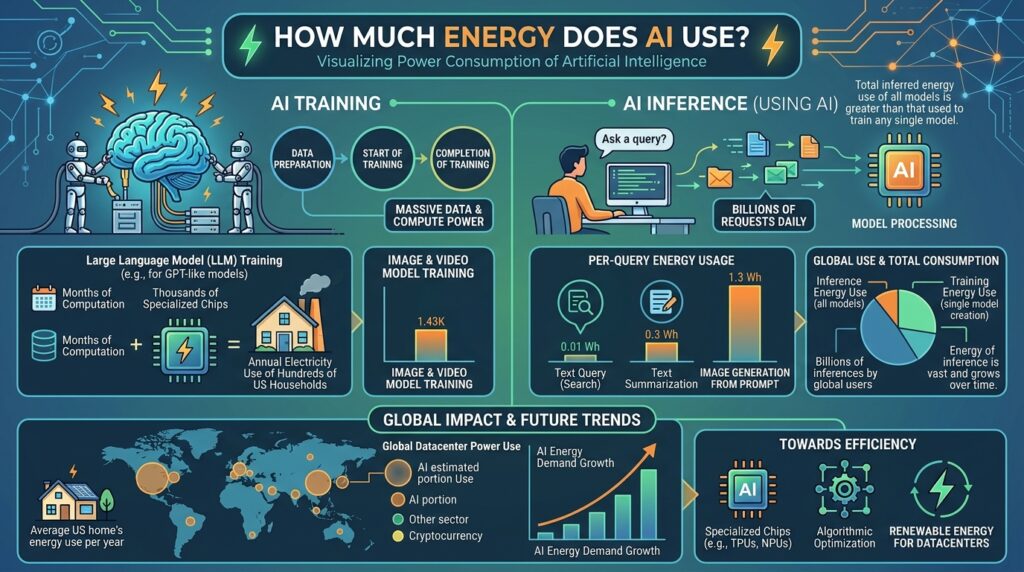
Training an AI model usually uses much more energy than regular daily use. Training means the system studies large amounts of data so it can learn patterns and improve its answers. This process can take days, weeks, or even months, depending on the size of the model.
After training, people use the model through normal prompts. This still uses energy, but usually less than the training stage.
Busy Hours Can Increase Energy Demand
AI systems may use more energy during busy times, such as work hours, school hours, or after a new AI product becomes popular. More users mean more servers may need to stay active. During slower hours, energy demand may drop, but data centers still keep many systems running.
How Much Energy Does AI Use Per Day?
Daily Use Comes From Many Small Tasks
AI energy use per day comes from many types of tasks. These include text prompts, search-style answers, image generation, coding help, voice tools, summaries, customer service chats, and other AI features.
Popular AI platforms may handle millions of requests every day. Each request uses some electricity because the system has to read the prompt, process it, create the answer, and send it back to the user.
Short Answers Use Less Than Heavy Tasks
A short answer usually needs less energy. A long answer, image, video, or detailed coding task can need more power because the system works harder and takes more time to produce the result.
Data Centers Run All Day
AI systems also use energy even when one person is not using them. Data centers run day and night. Servers stay online, data is stored, networks stay connected, and backup systems remain ready.
So, AI energy use is not only about the moment someone types a prompt. It also includes the power needed to keep the full system available.
Cooling Also Uses Energy
Servers create heat while they work. When data centers handle large AI workloads, cooling becomes very important. Cooling systems stop equipment from overheating, but they can also use a lot of electricity, especially in warmer locations.
Large Platforms Use More Than Small Tools
Small AI tools may use less energy because they serve fewer users or run smaller models. Large AI platforms use more energy because they handle more requests, bigger models, more storage, and stronger infrastructure.
So, daily AI energy use includes prompts, servers, storage, cooling, networking, security, backup power, and regular maintenance.
How Much Energy Does AI Use Globally?
AI Is Part of the Bigger Data Center Demand
Global AI energy use is growing as more companies, apps, and websites add AI features. AI is now used in healthcare, education, marketing, finance, customer support, software development, online shopping, writing tools, and many other areas.
AI is part of the wider data center industry. Data centers already support websites, cloud storage, streaming platforms, online banking, emails, business software, and social media. As AI grows, it adds more demand to this existing power use.
Exact Global Numbers Are Hard to Measure
It is difficult to measure total AI energy use exactly. Different companies use different models, chips, servers, and data centers. Some AI tools are small and simple, while others are very large and need heavy computing power.
Another reason is that many companies do not share full details about how much energy their AI systems use.
Some Countries Have More AI Power Demand
Countries with many large data centers usually have higher AI-related power demand. The United States, China, parts of Europe, and other technology-focused regions have many major data centers. As more AI tools are built, electricity demand in these areas can increase.
Cleaner Energy Can Reduce the Impact
Many technology companies are now looking for cleaner energy options. Some data centers use renewable energy such as solar, wind, or hydro power. Others are improving cooling systems, using better chips, and building data centers in cooler locations to reduce wasted energy.
AI’s global energy use will likely keep rising. The main issue is not only how much energy AI uses, but also where that energy comes from and how efficiently it is used.
How Much Energy Does AI Use Per Prompt?
Every Prompt Uses Some Electricity
Every AI prompt uses electricity, but the amount is not always the same. A simple prompt asking for a short answer usually uses less energy than a long, detailed request.
For example, asking AI to define a word may use a small amount of processing power. Asking it to write a full article, solve a coding problem, create an image, or make a video can use much more.
Task Type Makes a Big Difference
Text answers usually use less energy than image generation. Video generation can use even more because the system has to handle frames, movement, style, and details.
Coding tasks can also use more power when the answer is long or needs careful step-by-step thinking.
Longer Answers Usually Need More Processing
A longer response can use more energy because the AI model has to create more words. A short answer finishes quickly, while a long answer keeps the system working for more time.
In simple words, the more content the AI creates, the more processing it usually needs.
Main Factors That Affect One Prompt
Several things affect how much energy one AI prompt uses:
- Model size
- Prompt length
- Response length
- Type of task
- Server efficiency
- Number of users at the same time
So, there is no single fixed answer for how much energy one AI prompt uses. A basic text request may use very little, while advanced image, video, or coding tasks can use much more.
How Much Energy Does AI Use Per Year?
Yearly AI Energy Use Is Growing
AI energy use per year is increasing because more people and businesses are using AI every day. A few years ago, many people had never used AI chatbots. Now students, writers, developers, business owners, marketers, designers, and customer support teams use AI regularly.
Training and Daily Use Both Matter
Yearly AI energy use comes from two main areas: training and usage.
Training happens when a company builds or improves an AI model. This stage can use a lot of electricity because it may involve huge datasets, powerful chips, and long processing times.
Usage happens after the model is ready. This is when people use AI for prompts, searches, images, summaries, coding, and other tasks.
Billions of Prompts Can Create Big Demand
One prompt may seem small, but billions of prompts over a year can create a large energy demand. This is why AI energy use becomes more important as more people use it daily.
Future Use Will Depend on Efficiency
Yearly estimates can vary because not all AI systems are the same. Some companies use very large models, while others use smaller models for specific jobs. Some data centers are efficient, while others use more power.
The future of AI energy use will depend on better chips, smaller models, cleaner electricity, and improved cooling systems.
How Much Energy Does AI Use vs Google Search?
AI Usually Needs More Power Than a Basic Search
AI prompts usually need more computing power than a basic Google search. A traditional search engine mostly finds and ranks existing web pages. It does not always create a full new answer from scratch.
When someone searches on Google, the system looks through indexed pages and shows links, snippets, images, videos, or quick answers. This still uses energy, but search engines have been optimized for many years.
AI Creates a New Answer
AI works differently. When you ask an AI tool a question, it reads your prompt, understands the meaning, predicts the best response, and creates new text. This can need more computing power, especially if the answer is long or complex.
Simple Searches May Use Less Energy
A simple search like “weather today” or “best time to drink coffee” may use less energy than asking AI to write a full guide, compare choices, or create a detailed plan.
Search engines usually retrieve information. AI often creates a custom answer.
AI Can Still Be Useful
This does not mean AI is always a waste of energy. AI can save time by writing drafts, summarizing long information, explaining difficult topics, and helping people finish work faster.
The key is to use AI where it gives real value, instead of using it for every small question.
What Affects AI Energy Use?
Model Size
Larger AI models usually need more computing power. Smaller models can often handle simple tasks with less energy.
Number of Users
The more people using an AI system at the same time, the more servers and electricity are needed.
Prompt and Answer Length
Short prompts and short answers usually use less energy. Long prompts and long responses need more processing.
Type of Task
Text, images, audio, video, and coding tasks all use different amounts of power. More complex tasks usually need more energy.
Server Efficiency
Newer and better servers can process AI requests faster and waste less energy.
Cooling System
Data centers need cooling because servers produce heat. Better cooling systems can reduce extra electricity use.
Energy Source
AI powered by renewable energy has a lower environmental impact than AI powered by fossil fuels.
Data Center Location
A data center in a cooler region may need less energy for cooling. A data center in a hot area may need more.
All these factors work together, which is why two AI tools can use different amounts of energy even when they seem similar.
Can AI Become More Energy Efficient?
Yes, AI Can Become Cleaner
AI can become more energy efficient, and many companies are already working on this. The goal is to reduce the power needed to train and run AI systems without making the tools less useful.
Better Chips Can Help
One big improvement is better AI chips. Newer chips can complete AI tasks faster while using less electricity. This can lower the power needed for each prompt or task.
Smaller Models Can Reduce Waste
Not every job needs the biggest AI model. Smaller, focused models can handle simple tasks like answering basic questions, sorting information, or helping with customer support. This can reduce energy use while still giving good results.
Renewable Energy Matters
Data centers powered by solar, wind, hydro, or other cleaner energy sources can reduce the environmental impact of AI. The amount of electricity still matters, but the source of that electricity matters too.
Better Cooling Can Save Power
Since servers produce heat, better cooling systems can cut wasted energy. Some data centers use outside air, water cooling, or advanced cooling designs to keep equipment safe with less electricity.
Smarter AI Routing Can Help
AI systems can also send simple tasks to smaller models and save larger models for harder work. This helps avoid using more power than needed.
AI will likely keep growing, but smarter design can make it cleaner and more efficient over time.
FAQs
Does AI use a lot of electricity?
Yes, AI can use a lot of electricity because it runs on powerful data centers, especially when training and operating large AI models.
Is AI harming the environment?
AI can affect the environment if its data centers use fossil-fuel electricity or large amounts of water, but cleaner energy can reduce the damage.
Is AI a major drain on the world’s energy supply?
AI is growing fast, but it is not yet the biggest user of global electricity. Data centers used about 1.5% of global electricity in 2024 and may reach nearly 3% by 2030.
Did AI use more water than bottled water?
Some research says AI’s water footprint could reach a level similar to global bottled water use, but exact numbers are still estimates because companies do not share full data.
Final Thoughts
AI Uses Energy, but the Amount Varies
AI uses energy every time it processes a request. A simple prompt may use only a small amount of electricity, but when billions of prompts happen around the world, the total impact becomes much larger.
The Biggest Factors Are Size, Usage, and Efficiency
AI energy use depends on the model size, number of users, task type, answer length, server efficiency, cooling system, and energy source. Training large AI models can use a lot of electricity, while daily use adds up through millions or billions of requests.
AI Uses More Power Than Basic Search
AI usually uses more computing power than a simple Google search because it creates a new response instead of only showing existing results. Still, AI can be useful when it saves time, supports work, answers complex questions, or helps people complete tasks more easily.
The Future Depends on Cleaner Technology
As more industries use AI, energy demand may continue to grow. The future of AI will depend on making systems faster, cleaner, and more energy-efficient. Better chips, smarter models, renewable energy, and improved data centers can help reduce the impact while keeping AI useful.